Blog
How SMB Owners Should Choose a Marketing Site Stack
A practical guide for small business owners choosing between Wix, Squarespace, Webflow, WordPress, and a static-first AWS marketing site. SoulNest Pickleball shows why the platform should follow the requirements, and sometimes that's static AWS.
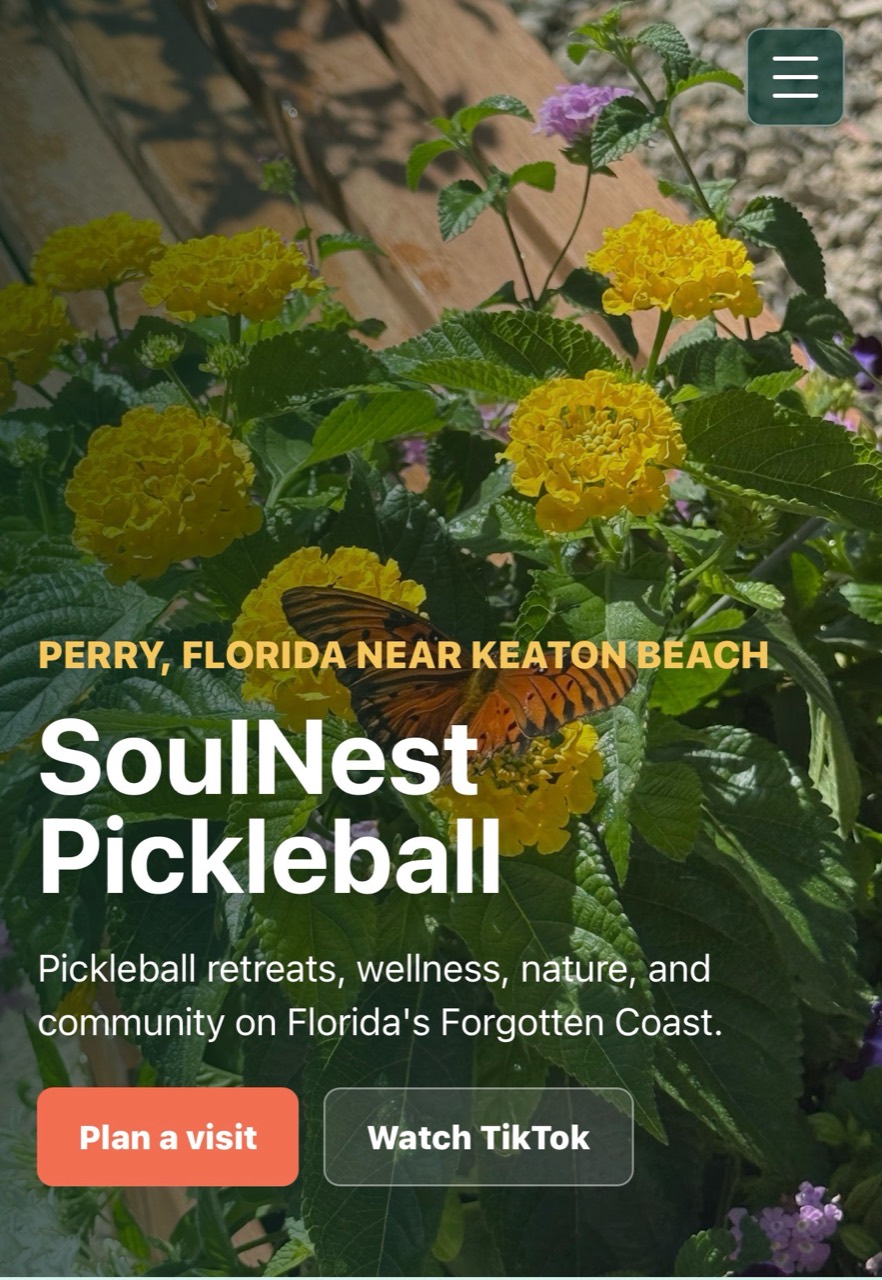
When a small business needs a marketing site, the default advice is usually Squarespace or Wix. That's sometimes correct. For SoulNest Pickleball, it wasn't, and the reasons make a useful case study in choosing infrastructure.
The platform should follow the requirements, and sometimes that's static AWS. A builder can be the right answer when the owner needs frequent no-code editing. A static-first stack can be the right answer when the business needs speed, ownership, preview environments, low running cost, and room for future automation.
If you're interested in pickleball retreats in Florida, check out SoulNest Pickleball.
The Client Need
The requirements really shaped our decisions. SoulNest wanted a public marketing site that loads fast and looks polished, with real media like photos and video, a working inquiry form, and SEO that can actually rank.
They also wanted a dev preview environment so changes could be reviewed before going live, plus a path toward future automation instead of a brochure that would never change. A pure brochure site has no real need for a preview environment or an automation roadmap. SoulNest wanted something that could grow into a system.

The Architecture
The shape of the system is small and legible.
Route 53 -> CloudFront -> private S3
                       -> Lambda for /api/inquiry
                       -> Lambda / SQS / Spark for dev feature requests
Route 53 handles DNS. CloudFront serves everything from edge locations, pulling from a private S3 bucket. The bucket isn't publicly exposed; only CloudFront can read it. Dynamic needs are handled by small, purpose-built Lambda functions instead of a general-purpose backend.
Why Static-First Was the Right Default
Pre-built files served from a CDN edge are faster than server-rendered responses on almost every page-load metric. Cost is lower because there's no idle compute. You pay for storage and the requests you actually serve.
Operational risk is lower because there's no server to patch, no runtime to keep current, and no database to back up for the marketing layer. Static assets cache cleanly at the edge, which helps both performance and cost.
Starting static closes no doors. Dynamic behavior gets bolted on where it's genuinely needed instead of becoming the foundation everything sits on.
Where the Backend Lives
Static-first still has a backend. The difference is scope. The backend handles exactly what needs backend behavior.
The inquiry form posts to `/api/inquiry`, where a Lambda validates the submission and Amazon SES sends the email. There's no server and no inbox integration to maintain just to process a contact form.
Feature requests from the dev environment land on an SQS queue and flow through a Spark approval workflow instead of directly mutating anything. When the site eventually needs more, the options stay open: Lambda and API Gateway for more endpoints, ECS for containerized services, or routing into an existing EC2 ingress. That decision can wait until there's a concrete reason to make it.
Real Cost Comparison
This part matters most to a lot of SMB owners. All figures below are estimates in USD as of mid-2026. Domain registration is excluded because a custom `.com` costs roughly the same on every option, so it doesn't change the comparison. Builder prices are list prices on annual billing. AWS is usage-based.

Hosted Website Builders
Wix: Light $17/month; Core, the recommended value tier, $29/month.
Squarespace: Basic $16/month; Core $23/month. Google Workspace email can add about $6-7/user/month after year one.
Webflow: Basic $15/month; Premium $25/month, which is the realistic tier for a content-driven marketing site after the May 2026 restructure.
Managed WordPress, including providers like Kinsta or WP Engine: about $25-35/month to start, scaling with traffic, before theme or plugin licenses.
The builder path lands somewhere around $180-$420/year for the platform alone, before email and any premium apps or add-ons. That cost is flat and recurring. You pay it at 10 visitors/month and at 100,000 visitors/month.
Static-First AWS
For a static marketing site, the AWS bill can be genuinely $0/month up to a surprisingly high traffic level, then scale gently from there. The binding constraint is usually CloudFront data transfer. AWS's perpetual free tier for CloudFront covers 1 TB of egress and 10 million requests per month.
A media-rich marketing page with photos and maybe a hero video might run around 4 MB per full page load. That math works out to roughly 250,000 page views per month before delivery cost becomes meaningful.
S3 storage for a few GB of assets is well under $1/month at this scale.
Lambda for inquiry and feature-request handlers usually stays inside the 1 million requests/month free tier for a small marketing site.
SES for transactional inquiry email is about $0.10 per 1,000 emails, which is pennies at normal inquiry volume.
Route 53 DNS is about $0.50/month per hosted zone.
Put plainly: under roughly 150,000-250,000 visits/month, the realistic all-in AWS bill is about $0-$1/month. The only line item that's reliably non-zero is the Route 53 hosted zone. Above that, CloudFront egress starts at about $0.085/GB in North America, which is roughly $0.085 for every additional 250 page views if the page averages 4 MB.
A site doing 500,000 visits/month, roughly double the free ceiling in this estimate, would likely pay on the order of $8-10/month total. Most SMB marketing sites never approach 150,000 monthly visits. SoulNest's realistic traffic puts it comfortably inside the free tier, so the honest running cost is effectively the Route 53 hosted zone, under a dollar a month, versus $15-35/month for a builder.
There's a catch. That near-zero figure assumes the build and deploy pipeline already exists. The cost moves from recurring subscription to upfront engineering time. Builders front-load convenience. AWS front-loads engineering and then runs almost free.
That's where DK Logics comes in. For something like this, you're looking at roughly 5 hours of engineering time. You get a workflow you can reuse, extend, and integrate almost anything into, and the monthly cost is basically $0 to run.
Comparison to Wix, Squarespace, Webflow, and WordPress
Cost is only one factor. The fuller picture comes down to the operating model.
Builders win on owner editing and speed to launch. If the person running the business needs to change copy, swap a photo, or publish a new page on a Tuesday afternoon, a hosted builder is hard to beat. There's no deploy step and no developer in the loop. Wix and Squarespace in particular are built around non-technical self-service.
AWS wins on control, extensibility, workflow integration, long-term architecture, and running cost. You own the stack, you can wire in custom logic and queues, and the site can become part of a larger system instead of living in a walled garden. The SQS plus Spark approval flow has no clean equivalent on a builder.
They optimize for different things. A builder optimizes for convenience and self-service editing. Static-first AWS optimizes for performance, ownership, integration, reproducibility, and low running cost.
Conclusion
The rule of thumb is straightforward. Use no-code when the business needs simple, frequent self-service editing more than it needs custom systems, and when paying $200-$400/year for that convenience is worth avoiding code.
Use static, CDN, and serverless infrastructure when performance, ownership, custom workflows, reproducibility, and near-zero running cost matter, and when the site is meant to grow into something more than a brochure.
SoulNest fell into the second category, so it got the second architecture. The platform should follow the requirements, and sometimes that's static AWS.
If your business is trying to decide between a website builder, WordPress, or a custom static-first setup, DK Logics can help map the decision to the actual workflow, budget, and future system needs instead of guessing from platform marketing pages.
Pricing Sources
AWS pricing references: CloudFront pricing, Lambda pricing, Route 53 pricing, and Amazon SES pricing.
Builder pricing references: Wix pricing, Squarespace pricing, Webflow pricing, and Kinsta WordPress hosting pricing.